So, in case you
haven't been following this particular story, in March of 2016, the National
Environmental Research Center in the UK launched an online poll to name a new
polar research vessel currently in development. It was meant to, in the words
of Britain's Science Minister Jo Johnson, to give the average Brit "the
opportunity to feel part of this exciting project and the untold discoveries it
will unearth." The vessel, costing $287 million, will study the effects of
climate change in Antarctica, and will launch around 2019.
This being the
internet, the most popular name voted ended up being "Boaty
McBoatface", as suggested by former BBC Radio Jockey James Hand (Hand
apparently now regrets the decision, and particularly the attention it got).
Despite it being the most popular name out of all suggested, NERC and the
British Science would have none of it. Very recently, they announced the vessel
would be named after Sir David Attenborough, famed naturalist and TV presenter
most famous for the "Life" series on the BBC. This was despite
Attenborough being only the fourth highest entry, behind Boaty,
"Poppy-Mai" after a dying, cancer stricken 16 month old girl, and "Henry
Worsley”, after a British Army officer who died attempting the first ever solo trek
through Antarctica. However, it's not all bad for the Boaty Camp. The name would be bestowed on a small remote operated submarine, which collects data for the research team.
So, why am I talking about this? Well this was all prompted by this comment on the NPR coverage of the story (Link in the sources), by a fellow named "No One":
It's not that they didn't want to use the results, it's just that the results have to be reasonable. I'm sure people will participate in future polls in large numbers, despite this. The only ones who wouldn't are the same childish fools who voted for a ridiculous name; and I doubt those people know or care what the research vessel is for in the first place.
But would they? Even you weren't particularly inclined to vote for this name, (like I was),after the NERC decides to disregard what the public wanted for the name, would you choose to vote again, knowing that they could disregard whatever was most popular name, whether it be silly or dignified?That herein lies the main issue with the whole ordeal. Even if the name was absurd (and admittedly David Attenborough is a more appropriate name and tribute to a fantastic nature documentarian), it was the name that the public did chose, and if the NERC didn't like the name, and intended to use a different one, why even engage with the poll? It discourages people from taking part in scientific research, however small the role, and even people who don't like the name might not like the idea of voting. To address the second part of Mr. Nemo's comments up there, Yes, the people who voted for the name may not have known what the vessel was for, but bestowing upon it a name like that may help popularize the vessel, get people engaged in what research the ship is engaged with. Hell, the controversy increased the visibility of the ship. I probably wouldn't have heard of the vessel, unless it was mentioned in a National Geographic article. Yes, the people voting may not have known or cared, but having a popular name on the ship may have gotten them to care. And it has gotten people to care about this ship, because the common refrain on the ship is "It'll always be Boaty McBoatface to me."
I'm not upset about the name. I don't find the name particularly appealing, and like I said, "David Attenborough" is far more appropriate name. What does concern me is the fact that the public was invited to participate in very important research, and they were disregarded. This highlights a growing rift between the public and the scientific community. The average person regards most research as esoteric and incomprehensible, thus the rampancy of scientific illiteracy amongst the public. John Oliver did an excellent piece on his HBO program "Last Week Tonight", on the simplification of scientific research in popular media (and I suggest you look at that). And in recent years, the scientific community has begun outreaching to the general public, with popular science books being published and science documentaries becoming popular. However, when incidents like this occur, it tells the average layman that science is an incredibly closed process, and participation is cut off to them. This could not be further from the truth, but this perception opens up a whole litany of problems, from minority representation in science, to funding for the sciences to the aforementioned scientific illiteracy. Especially the latter. Remember, the ship was meant to survey Antarctica to study climate change. Since this controversy, perhaps people will be more invested in research, and they might realize that just because it snows in Minneapolis in December, that does not mean that climate change isn't real. If people have more participation in science, they could be more invested in it, and they could more easily understand how process of research works, and perhaps encourage them to be more invested in research.
I would be lying if I said that I didn't understand the fatigue with superhero films. There are a lot of them, and the massive corporations that create them do market them excessively. There are a lot more planned in the future too. Then again, trends like westerns or slasher film had similar runs in the 50's and 80's respectively. But, you know what irritates me more? People complaining about superhero movies. Seriously, it seems every day I see a comment or a think piece about superhero movies are too much, and how they are distracting from films that are"true art" or some cockamamie like that. It is just so... hipster, for lack of a better term. Pretending to be some sort of intellectual insight by disparaging popular forms of media. You ever hear the phrase "Just because it's popular doesn't mean it's good?" Well, these people apparently take that to mean that "It's popular, ergo it's bad, and it's popularity indicates the fall of cultural tastes," and I wrote a whole piece on that a month or so ago, so go read that. Again, I understand if people are tired of superhero movies. I was admittedly starting to grow tired of them as well after Age of Ultron. Even the surprisingly good Ant-Man wasn't spectacular, and didn't help me appreciate the genre. Batman v. Superman was so dull, I thought perhaps the experience watching that may dull my experience watching Captain America: Civil War, because it indicated my fatigue with superhero films. Actually, watching Batman v. Superman actually enhanced the experience of this film, because I realized what that film did wrong, and what this film did right. It also reminded me of why Marvel movies are so well-regarded. They do put more effort into the scripts and acting, and they actually know what the fans of these films want. So, with that introduction out of the way,...
Based around the Marvel comics character created by Joe Simon and "Jolly" Jack Kirby, Captain America: Civil War once again follows the adventures of Steve Rogers, Captain America ( Chris Evans). The new Avengers assembled at the end of Age of Ultron (Scarlet Wtich (Elizabeth Olson, who I learned is the younger sister of the Olsen twins), Black Widow (Scarlett Johansson), and Falcon (Anthony Mackie)) are on a mission in Lagos, where they try to stop the assassin Crossbones (Frank Grillo) from attaining a biological weapon. When Crossbones detonates a bomb on his person, while Cap is interrogating him, the Scarlet Witch contains the explosion, but releases it at a nearby building, killing several workers from the small East African nation of Wakanda. International condemnation ensues, and Secretary of State Thaddeus Ross (William Hurt) tells the Avengers that due to the number of incidents where they were involved, and people were killed, the UN wants to institute the "Slokovia Accords", which would place them under a UN mandate. Tony Stark, Iron Man (Robert Downey Jr.) supports this measure, along with Black Widow and War Machine (Don Cheadle), but Cap is skeptical. Cap learns of the death of his former girlfriend Peggy Carter (Hayley Atwell), and attends the funeral. There, he meets her niece Sharon (Emily VanCamp), a CIA operative in Germany. At the signing of the Accords in Vienna, a bomb goes off, killing the Wakandan King T'Chaka (John Kani). The blame is quickly placed on the Winter Soldier, aka "Bucky" Barnes (Sebastian Stan), Cap's best friends turned HYDRA assassin. T'Challa (Chadwick Boseman), the prince of Wakanda, swears vengeance, and adopts the "Black Panther" moniker, one which has gone down generations of Wakandan warriors.Cap knows that Barnes has been framed, and Barnes professes as much when Cap confronts him. When Cap and Falcon try to protect Barnes from government agents, they find themselves enemies of the government, and Stark. Can they prove Bucky innocent, and get into a conspiracy to split the Avengers?
This is much more serious than any of the previous Marvel movies, going off the darker tone of The Winter Soldier. There are less jokes or very funny moments. Unlike Batman v. Superman, however, it works to the film's advantage, underscoring how intense and serious some of the moments in the film are. There are several scene, which are legitimately shocking to see. The events also have more weight and consequence to them, unlike Batman v. Superman. I feel more invested in the events happening. The action is very good, as usual, and I feel more excited watching it. As always, the cast is absolutely great. A particular stand out is Tom Holland as Spider Man (who appears later in the film, so I didn't mention him in the synopsis), who manages to do a good job trying to separate himself from Toby Maguire and Andrew Garfield. I also liked Spider-Man's costume, which resembles the iconic Steve Ditko look of the 60's. Chadwick Boseman does a very good job as the Black Panther, and I'm very excited for his solo film (I'm a fan of that particular character). While not using the comic's "Superhuman Registration Act", it does provide some interesting questions on whether the Avengers should intervene with supervision, and the conflict within the Avengers feels real, and builds on the characterization of team since their inception back in the original film. A recurring theme is the idea of revenge and hatred, which causes some characters to overreact and make some poor decisions.
Like I said, I liked Spider-Man, but honestly, he could be cut out of this film. I wish he played a larger role, just so that his presence is justified a little more than "We would like to introduce the MCU Spider-Man, before we put him in a movie". Also, the motivation of the villain is less than satisfying. Given the wide scope of the conspiracy, I thought that there would be more, but no, the reason the villain (not spoiling who it is) is doing this is very simple. Given the scope of the events, it is very disappointing. The inclusion of the other Avengers, while necessary, sometimes distracts from Cap and the Winter Soldiers, who are supposed to be the main focus. Finally, while the title is appropriate, they should have incorporated more elements from the comic version. It could've justified the title.
This was far better than Age of Ultron, and it restored my faith in Marvel. If you want a good superhero film after Batman v. Superman, or you enjoyed most of the previous Marvel films, this is the film for you. If you don't like Superhero movies, I don't think this will change your mind, but I'd say give it a chance, because there are elements of spy films in this. Overall, very exciting and very fun. A rare quality in today's blockbusters.
A very common complaint about the modern film industry is that everything is derivative. Most of the big blockbusters are either adaptations of popular superhero comics, young adult novels, novels in general, or are outright remakes. Whilst not necessarily invalid, this doesn't mean that any of these films are bad by any measure. Most of the Marvel films have garnered mostly critical acclaim, for instance. And the recent crop of Disney live-action reimaginings have seen some positive reviews. Given Disney's recent live action offerings (John Carter, The Lone Ranger, Tomorrowland), perhaps that's a bit of relief to the House of the Mouse. Especially the critical and financial success of today's subject, The Jungle Book. The success of this, and other recent live action remakes, has ensured that other Disney animated films are remade. Relatively recent ones too, like Mulan or Aladdin. But, is this truly as good as the critics say. Let's take a look.
A remake of the 1967 Disney animated film (which is, in turn, very loosely based off the first three in the 1894 collection of stories of the same name by Rudyard Kipling), The Jungle Book revolves around Mowgli (Neel Sethi), a feral child raised in the jungles of India by a pack of wolves, led by Akela (Giancarlo Esposito) and Raksha (Lupita Nyong'o). During the dry season, a "Peace Rock" is revealed in a dried river, which is an indication of a truce amongst the animals. Basically, during this period, carnivores can't eat herbivores. However, during this truce, the ruthless tiger Shere Khan (Idris Elba), learns of Mowgli's existence. Given his hatred of humans, Shere Khan demands that Mowgli be turned over to him, or else. Mowgli decides, in order to protect the wolves, to leave, and his mentor, the black panther Bagheera (Ben Kingsley) accompanies him to the man village. Mowgli is reluctant to go to the man village, given his upbringing by wolves. However, Shere Khan ambushes Mowgli, and separates him from Bagheera. Mowgli wanders the jungle, encountering colorful characters, the sloth bear Baloo (Bill Murray) (who doesn't at all look like a sloth bear, a very small thing that bothered me through the film), the Gigantopithecus King Louie (Christopher Walken), and the python Kaa (Scarlett Johansson). Can Mowgli evade Shere Khan, or can he control the power of man's red flower (and apologizes if that song's stuck in your head for the next week) to defeat Shere Khan.
First, the film looks very impressive. Very distinct and colorful. The talking animals feel real, not just computer constructs. The jungle also looks very lively, and very real. While I do often complain about the use of 3-D in films, I did think this looked very impressive in 3-D, and if you wanted to watch it, I do recommend watching it in 3-D, because it does enhance the look of the film. Most of the actors do fine. Neel Sethi wasn't great, but I'll give him a pass, because he's only ten, and I'd feel like a jerk for criticizing his performance. Ben Kingsley and Idris Elba do fine in their respective roles (Kingsley sounding very similar to Bagheera's original voice actor) . Bill Murray was perfect casting as Baloo, and he is, of course, very entertaining to watch. And Christopher Walken as King Louie was hilarious. He's supposed to menacing, but with Walken's signature voice, and him randomly breaking into the chorus and second verse of "I Wanna Be Like You", it was frankly hard to take him seriously (also, insert Donald Trump joke here). He's not bad, by any means, and when he chases after Mowgli at the end of the scene. I just cracked up during his appearance. It was entertaining to watch.
A few odd, superfluous choices bothered me through this film. Like I said, Baloo is supposed to be a sloth bear, as he was in the novel and the film. However, this is what he looked like in the film:
That relatively minor thing bothered me. King Louie being a Gigantopithecus also was unnecessary. India and Sumatra are not that far away, You could just had an Orangutan wash up there after a storm or something like that. Having him be a prehistoric ape seems excessive. Also, he and Kaa were just devices to explain important plot points. Otherwise, they serve no real purpose in the story. The rendition of "I Wanna Be Like You", like I said, comes out of nowhere. They sing "Bear Necessities", of course, but it made more sense in the scene it was in. While they are trying to take the animated version, and make a more serious version, they also bring in elements from the Kipling stories. The Wolves play a larger role, as they did in the story, the Law of the Jungle poem is recited, the monkeys are called "Bandar-Logs"(and they butcher the pronunciation of it) and several minor characters from the book make cameos. This doesn't come off as a way to balance the two, since most of the rest of the film is derived from the 1967 film. If you're going to remake the 1967 film, you could just take elements from that. Don't randomly place stuff from the novel, and do nothing with those, because none of those additions really add to film. Finally, the ending completely misses the point of the story, both the book and the Disney film. I won't spoil it, but you've seen or read any variation of this story, you get the general message of it. However, the ending just completely botches it, and misses the whole point.
If you were looking for a film version, which is very close to the Kipling stories, like I was, you will sadly be disappoint. Just for some recommendations in that case, animator Chuck Jones (who was a very prominent animator in the Golden Age Looney Tunes shorts, and later directed How the Grinch Stole Christmas) did an animated TV special based on Mowgli's Brothers in 1976, which is considered one of the closest adaptation of the story ever made (Sadly, he was never able to adapt the other two stories.) If you enjoyed the Disney version, it isn't a musical, and it is more intense, so you might not enjoy it as much, though you might like the Bear Necessities rendition. Some might enjoy just the visual and the action sequences, so I'd recommend it. Overall, this was okay. Can't really muster any strong emotions about it. It wasn't nearly as good as the original. In fact, just watch the original. It has all the classic songs, and the decent animation. Yeah, it hasn't held up particularly well, but it is much better than this. However, this wasn't bad. Just, not really interesting or new. Hopefully, the Warner Bros version coming out next year will provide a more interesting retelling of this story.
Before I dive into a full weekend of studying for my exams, I might as well get another opinion piece out (long time since I did one). So, recently (past 5 or so years) some individuals have expressed concern that adults are becoming enamored with stuff designed primarily for children. Perhaps the one in most recent memory was Ruth Graham, whose piece in Slate "Against YA" stated, in an example of Slate's very high standard of journalism (okay, to be fair, they have Phil Plait, so that's one thing worth reading on that website), that adults should be "ashamed" if they read YA novels, because of their general lack of sophistication compared to adult literature. Later, New York Times film critic AO Scott used Graham's article, and echoed such sentiments in his article "The Death of Adulthood in American Culture", but extending it to general culture, stating that adults being interested in things meant for younger audiences is an indication of the decline of adulthood in America. Finally, Alan Moore (who, for full disclosure, is one of my all-time favorite writers, and whose influence on the comic medium matches those of Eisner and Kirby) said, as he continues to shun society in general, that the current fixation on superheroes shows that culture has stagnated, and he fears that society will not produce any more culture, because people are more obsessed with recreating their childhoods. Through my readings of these statements, I have ruminated on the subject, and came to a conclusion, that in hindsight, I should've had at the very beginning: You should not judged for your tastes in anything, and the civilization is not going to come to an end just because people happen to enjoy children's stuff.
Now that I've stated my thesis, I want to go into this idea of "intellectually stunting" and why no one should care. To be fair, both Smith and Graham did constantly state that people should be allowed to read what they want. However, Graham went on to say that adults should "know better," and implored adults to read more sophisticated literature. I'm not objecting to her saying adults shouldn't read YA books, because that's not what she's arguing. No, she's arguing that people shouldn't only read YA novels, because that would intellectual stunt their development. I could go on an eloquent rant, filled with multi-syllable words and the like, but I'll just put it bluntly: 1.) Reading or consuming any one genre is stunting growth. Part of the idea of intellectual growth is expanding your horizon. One could argue that reading only high literature is a form of intellectual stunting, because you can't get the perspective of more popular forms of media. The whole point of "intellectualism", however nebulous a term that may be, is going and learning many different disciplines of knowledge. But, and this is my main point. If a person decides to only read YA novel, what business is it of hers? If you only want to read a certain genre (the idea of "young adult" as a genre is up for debate, but that's neither here or now), you should not be judged. You should be allowed to like whatever you want. And that's not to say, at time, I too bemoan the fact that the endless slew of indistinguishable "Hunger Games" rip-offs seem to dominate cinematic trends at the moment. But, I don't actively judge people for not going to see more interesting movie (feel free to point out instances where I do, because my fickle-mindedness goes hand and hand with poor short-term memory.) I am also saying read what you'd like. However, I'm adding the caveat "and you shouldn't be judged." People should generally be allowed to have their own taste, and enjoy their own preferences without being mocked. It is none of my business what you like to read, or watch. Like what you like, I might not like it, but I'm not going to disparage your love of something. I enjoy many childish things, and there is old adage about people in greenhouses and stones.
I'm certainly not going to imply that liking something will lead to Armageddon. Yeah, they don't say, but that's the logical extension of it. Especially Smith's piece. It implies that adulthood as defined.... in some arbitrary way he never bothers to explain, is on the decline, and that people might go into a "perpetual childhood." Moore's statement is also an example, stating that people are no longer interested in making new culture, and cultural decay was a major theme in League of Extraordinary Gentlemen volume III (whose promise was squandered by incomprehensible episodes involving drugs and occultism, by the way). xkcd did a good job with this: https://xkcd.com/603/ . And it's right. This sort of moralizing is similar to people who complain about certain societal attitudes leading to societal decline. Ladies and gentlemen, The Epic of Gilgamesh, the earliest recorded piece of literature, dates back to 2100 BC. The fact that the Avengers is one of the highest grossing films, is not going to cause culture to stagnate or decline or become less sophisticated. Human culture is too fickle for that. We still have original, mature being produced, and still getting some attention, if not most of it. We are not, nor never (unless nuclear war breaks out, or a meteor hits) going to be in societal decline anytime soon.
The best encapsulation of adults liking childhood things is by CS Lewis:
"
Critics who treat 'adult' as a term of approval, instead of as a merely descriptive term, cannot be adult themselves. To be concerned about being grown up, to admire the grown up because it is grown up, to blush at the suspicion of being childish; these things are the marks of childhood and adolescence. And in childhood and adolescence they are, in moderation, healthy symptoms. Young things ought to want to grow. But to carry on into middle life or even into early manhood this concern about being adult is a mark of really arrested development. When I was ten, I read fairy tales in secret and would have been ashamed if I had been found doing so. Now that I am fifty I read them openly. When I became a man I put away childish things, including the fear of childishness and the desire to be very grown up.”
Whilst I don't agree with Lewis on a number of issues, I can agree with this sentiment. Adulthood means that you have reached the point in your development, where you are generally rational enough from experience or learning to make your own decisions about what you want out of life and what you enjoy. Yes, you have a number of responsibilities, indisputably, but you are at the point in live where what you like is what you like. And you shouldn't be ashamed of liking stuff meant for kids, if you enjoy it as well.
Live Long, and Prosper. (I know this has nothing to do with Star Trek. I just needed a good closer)
This was originally going to be a review of Fred Hoyle's The Black Cloud, but my workload has prevented me from finishing that work at the moment. When I do finish, I will make sure to post a review of it. For now, here is a review of a book I read in one go a few months ago. When you think of North Korea, you most likely think of the lunacy and caricature of its ruler, Kim Jong Un. However, beyond this, there is still a nation of people suffering under a complete totalitarian regime, which controls every aspect of their lives, with little hope of escape. Beyond the pompous absurdity, there is a real horror that presides over the regime. And much of that is the result of the ruling Kim dynasty. Their grip on the entire country is so absolute, it bends to their will completely. Believe it or not, though, there was a time, when the leadership was interested in creating a good image of itself (As opposed to today, where the Dear Leader does what he wants), and the best way to do that was film. Exporting quality films could show that North Korea wasn't nearly as bad as people assumed. However, the North Korea "film industry" was a mere machine to produce propaganda films venerating the Kims and the whole Jurche ideology, with very little artistic value. Kim Jong-Il, the son of the original Dear Leader, Kim Sung-Il, and a huge movie buff, wanted to change that. He wanted to show that North Korea could make great, popular films, and those would help popularize North Korea among the world community. And he had a plan to do just that. A Kim Jong-Il Production, written by journalist Paul Fischer, details the story of a filmmaker and his actress wife, who are both kidnapped by Kim, and forced to serve as the filmmakers of the Hermit Kingdom. And we will take a look at it now.
(Note: I do not know Korean or how the Korean name system works, so I might refer to some people incorrectly. My sincerest apologizes if I do.)
Shin Sang-Ok was one of the most acclaimed directors in South Korea during the 50's and 60's. His wife, Choi Eun-hee was one of the biggest stars in the country. The two of them had a whirlwind romance, despite Choi being married, and they were one of the most famous couples in South Korea, being personal friends of the South Korean dictator Park Chung hee, and his wife, Yuk Young-soo, among other. Shin was overly dedicated to the art of filmmaking, and he and Choi had their own studio. Choi also ran her own acting school to teach a new generation of South Korean Thespians. However, this was soon to end, as Shin had an affair with another actress, whom he impregnated. Choi divorced him, and he also ran afoul with government censorship, which ultimately led to a shutdown of his studio in 1978. Meanwhile, Choi struggled to maintain her school, which led to her accepting an offer from Hong Kong, which would have helped her school. And she ends up getting kidnapped. After a long boat ride, she eventually finds herself in North Korea (a country she had fled during the Korean War), and has a face to face encounter with Kim Jong-Il, the son of the founder, Kim Sung-Il, who keeps her as a prisoner. Meanwhile Shin investigates his ex-wife disappearance in Hong Kong, but is himself captured. He is tossed around the infamous North Korean prison system, kept alive for mysterious reasons. Finally, in 1982, he is reunited with his wife, and Kim Jong-Il himself comes to explain their presence. He wants to project the glory of North Korea to the entire world, but he needs some actual good films, not just state propaganda. He hopes to utilize the talents of Shin in order to make those films. Kim makes Shin a cultural official, and he and Choi once again make movies. Of the films made in North Korea, the most notable and well-known is 1985's Pulgasari, a pseudo-Kaiju film, revolving around a mythical creature who is called upon to kill an oppressive warlord by a village under his rule....only to himself oppress the villagers himself. (Subtle....)Despite being directly under the thumb of the son of the Dear Leader, the two still plot their escape. They eventually carry it out while in a film festival in Vienna. They slip past their North Korean detail, and drive to the American embassy, where they ask for asylum. While Jong continued to rise through the ranks to eventually succeed his father following the latter's death in 1994, Shin and Choi spend time in the US, getting reacquainted with some of their South Korean friends and family (including their children). Shin tried to start a career in Hollywood, directing, among other things, the third 3 Ninjas film (remember that franchise? Yeah, me neither), and a Romanian co-produced remake of Pulgasari called The Legend of Galgameth, before finally coming back to South Korea to dispel rumors that they had willingly defected to the North. They remained there, until Shin's death in 2006.Choi Eun-Hee is still alive, and living in Seoul, where the book concludes.
This book was very well researched. The writer derived most of his information from Shin and Choi Korean language memoirs, but, as he details in the afterword, Fischer went out of his way to really verify the story, and make sure that every word is accurate, at least to the extent that he could. And frankly, the story is quite hard to believe at points. The North Korean state really is as absurd and extreme as the news often states. However, there were many horrors that many don't know about. Shin and Choi's kidnapping? That was actually very common, and not just from South Korea. They would kidnap people from Japan, Hong Kong, and even as far away as Jordan. They didn't target them, but just kidnap them at random, and try to train them as spies. They also had this massive drug dealing empire to help fund the government. North Korea also had an extensive prison system, where the tiniest offences could lead to not only you, but your entire extended family. It really does hammer in the horror of the regime. Equally disturbing and absurd is the life of Kim Jong-Il, who would often hold absurd and bizarre parties, but still had enough power to force people to play along. Among the examples of his power was killing an actress whom he had an affair with, after she eloped with someone else and tricking the actor who played Godzilla (the guy in the suit) to star in Pulgasari. An entire mythology has been concocted about the Kims, ensuring that the population is under their complete influence, in an almost religious fashion....
As this is a non-fiction work, I don't really want to criticize the story, as it likely happened as described. It's hard to criticize reality, after all. That said, the writer could have added more detail to actual films that Shin made in North Korea. Pulgasari is covered in some detail, as it was the most well known (and worst) film out of this period, given it was smuggled to Japan shortly after its release. However, more detail on the rest of the films would have given a better impression of Shin's North Korean films. He also never puts up any other accounts beside Shin and Choi's. It would've been nice to see the perspective of the two from others who knew them, even if most of them are deceased at this point, and it's hard to find such perspective.
I suppose this book has some new found relevance in the world, with the whole controversy with The Interview and the Sony Hacking last year. Reading such an account does provide a nice look into the North Korean government's feelings on the film medium itself, and why a harmless James Franco-Seth Rogan comedy could send them in such a frenzied state. They realized that film is a powerful medium, which has the ability to influence the way people view reality. Really, that's something most people realize now. So, if you want to read an extraordinary account of surviving in the Hermit Kingdom, or just want something to past the team, I suggest giving it a read.
Ah, another year has passed. This year, we saw the first photos of Pluto, found evidence of water on Mars, the Dawn spacecraft orbited Ceres, and also the atmosphere of Mars is slowly being depleted (I'm studying Astronomy in college, can you tell?) We saw same-sex marriage being legalized in the United States and Ireland, the deaths of several longtime actors and singers. and what is sure to be a very interesting US Presidential election. (The common complaint that it isn't 2016 is hence no longer valid). Meanwhile, the world suffered through the Paris attacks, the earthquakes in Nepal and the floods in Chennai, the collapse of martial rule in Burma, and the continuing scourge of Islamic terrorism in the Middle East and North Africa. But that's not what you're here for. No, you're here, (maybe) for the movies. 2015 proved very rewarding in film. Many notable films were released this year, some of which were able to become very large cultural phenomena. Of course, there were duds, but there are a great many good films to balance it out. And we're going to take a look at some of them. Once again, these are restricted to film released between January 1st and December 31st, 2015, that I watched in that particular time period. So, if it's off the list, I didn't see it. The list works, such that the first movie you see is the worst I saw all year, and as you go down, they improve, until the final entry, which is the best film. Now with all that out of the way, let's dive right in, folks:
Yeah, I was way too kind to this film in my initial review. Like I said in the spoiler review, the more I thought about this film, the more I grew to despise it. My distaste was not derived from some narrow-minded irritation at the film's message. I sympathize with its message. However, it ultimately lacked any substance to really back that message well. In the end, it ultimately lacked the narrative substance to really make the message stick, without sounding preachy (which it did, a lot). Speaking of narrative, the story and tone are both messy and cluttered, which makes the message even more apparent to rise above the mess, ruining any subtly. It's a real shame this had to be so bad, because I wanted to like this. I was massively hyped for this film, and it just came up short. So much potential to be a great family film, which promotes science and innovation, with Brad Bird directing. And the product was just... That's why it's my worst. It had all the potential to be great, and it just wasn't.
On the other hand, this film was not disappointing in the slightest. It gave me exactly what I was thought I was going to get. Aside from the gimmick of filming entirely from the perspective of a computer, this is ultimately a typical cliched slasher horror film, where a bunch of annoying teens are offed one by one. The computer screen technique is initially moderately interesting, (and by far the only thing people are talking about), but it ultimately fails to save the lack of real scares this supposed "horror" film actually has, and the sheer annoyance of the characters. The damn name sounds like a hashtag should be put before it. I probably should have stuck with my gut feeling about this.
Aside from some legitimate good moments in the 60's, and Paul Dano's performance as Brian Wilson, and despite the ramblings of the filmmakers, there is nothing distinguishable about this musical biopic. It is pretentious. Very pretentious, and it has John Cusack. As John Cusack trying to play Brian Wilson. (Why do they keep miscasting John Cusack as historical figures). Overall, this film biggest sin is, despite its very impressive cast, being largely unmemorable. It isn't unwatchable, and the story of Brian Wilson making Pet Sounds and later suffering from drug addiction is very fascinating in its own right. It just doesn't come through in this film.
Another film that is greatly pretentious. And also trying way too hard not to be "another teen film." This is an adaptation of a book, and they want you to know that, because it is separated into "parts", which are usually (and should only) be seen on the DVD menu scene selection. I haven't read the book, and after watching the film, nothing in it makes want to go and actually read it. The story is not really that original , despite the at times annoying narration insisting it is. Once again, there are several legitimately good moments that save this film from being totally dull. However, it, to be frank, doesn't warrant much interest. Also, the title. You know, if the title of your work sounds slightly absurd, Cross It Out, and Think of Another One.
I somewhat liked this film the first time I saw it. Now that a few months have passed, I've really thought it through, and realized that this didn't work well. The problem, I think, is the film struggles to really pinpoint its characterization of Christian Longo. I understand they are trying to make his character ambiguous, but the character changes from scene to scene. This makes his characterization inconsistent, and ruins the idea that he is a complex, ambiguous figure. Of course, he is, if you can't keep the character straight. I didn't know the real story that well before watching, and after watching, I know precisely the same amount about it. What keeps this off the bad list is James Franco's and Jonah Hill's performances, and the fact I saw this on a plane, meaning I didn't actively give money to see it.
These two are on the list, because I disliked them for the exact same reason. Technically competent action films, which ultimately failed to be really interesting in their own right. In The Man from UNCLE, while the action and acting were decent, it ultimately underutilized its 60's, Cold War setting, and the fact an American and Soviet agent had to work together. Both would have made the film infinitely more interesting. Instead, it is simply a generic action film, with a somewhat interesting setting. I hadn't seen the original show, but I know it has a reputation for heavy camp, and aside from some silly moments, it fails to really use any campiness, to make the film more enjoyable. It was just a (perfectly fine) generic action film. The same with Avengers: Age of Ultron. Again, perfectly fine movie. It's just.... generic. Yes, all the classic Marvel humor and the epic action was there. However, it simply doesn't have much else. Especially since the original had all this film does, but does it much, much better. The original manages to create a great superhero action film. I like Superhero films, so I'll see Captain America: Civil War, but they do need to space them out more, that way superhero fatigue doesn't start to kick in.
Why was this in two parts? Oh, yeah, that's right. Money. Seriously, this film dragged on and on for what seemed like an eternity. That's what happens when you adapt half of a book. You have to pad it out. That's primarily why this is so low on the list. It's length, and the lack of any real action for most of that length ultimately ruined the whole film for me. While Jennifer Lawrence and the others gave a good performance, it struggled to really maintain interest, until the end, where it finally picked up. At the very least, it was a good conclusion to the franchise.
Like I said in the review, I liked this better than Jurassic Park III. Of all four films, the third one is the worst, mostly because it seems like a retread of both the previous films, but with all the tension taken out. This film was at least original. It took this franchise in a new and different direction. Hell, this could have been a sequel Crichton himself could've written. It also had some good acting, and some good practical effects, homaging the first film. But that's the problem. It focuses a lot on homaging the first film, and the film ultimately suffers, because it can't really stand on its own, without being close to the original. That, and a villain Sue are the two biggest problems with this film.
This is the part where I stop complaining. In a half a decade of various interpretations of the Sherlock Holmes character, this is a fresh and interesting look into the character. How his persona had been exaggerated in the Watson stories, much as sometimes real figures are exaggerated. Ian McKellan gives a great performance as the aging Holmes, whose skills have declined with his age. Mr. Holmes is also a nice stand alone story about a detective who is trying to remember his last case, despite early Alzheimers, and also befriends a young boy, and how that boy helps him remember. If you have any interest in the classic Conan Doyle character, I say give this a watch.
Once again, I put these two in the same slot for the same reason. Surprisingly good kids film. I had somewhat low expectations for both of these films, but they honestly surprised me. For Minions, I was not a big fan of the Minions in Despicable Me, and I never though they could hold theirown movie. However, there were some pretty good jokes and gags, utilizing their sixties setting well, It was surprising how subtle some of these gags were. For the Good Dinosuar, I had low expectations based on the trailer, but the actual film, despite having basically the same plot as Super Mario World 2: Yoshi's Island, was actually a decent children's hero's journey, with some fascinating characters along their journey. However, it still wasn't Pixar's best, not even this year....
Once again, not much to say on this. It captures the spirit of the old cartoon shorts, and does justice to the Shulz strip (not surprising, given his son and grandson wrote and produced the film), which is shown in how Charlie Brown is a loveable loser. And there is enough Snoopy in this film to entertain everyone. And there is never too much Snoopy in anything.
I was too harsh on this film in my review. Not even on the whole film, just the third act. It's not bad, in any way. It's good as a conclusion. It's just the third act in the book was less rushed, and took more time. The book had a good ending, and I did want to see that on film. While the film's ending is fine, the book had a sweet ending, which still tied all the loose ends to some extent. You know what, I should probably shut up about the book. This is still a decent teen film, with a decent cast, which would satisfy any John Green fan, or anyone wanting to watch a film on a lazy Sunday afternoon.
The one thing that I was told going into this was that this was a very disappointing film, especially in regards to Skyfall. I agree, but I still felt this held up on its own. All the things that made Skyfall good were in Spectre (except for Spectre's song, which I thought was dull and uninspired). I finally like Daniel Craig in this role, and Christoph Waltz was a good villain (won't spoil who he turns out to be). Overall, I thought this was decent, until the end. The ending sucked. I won't spoil it, but it really doesn't make much sense. Not the villain's scheme, nor Bond's actions. Still, I can't in good conscience call this bad.
Of the two movies that came out this year based of 60's spy shows, this was the better one. Despite not having a tense moment of Tom Cruise moving off the highest tower in the world, it still had some nice tense action scenes, and a gripping plot, which sees the IMF disbanded, and Tom Cruise going rogue to find the Syndicate. Yeah, nothing deep, but it was enjoyable to watch, despite this being the 5th in this franchise. This has proved to be a very durable franchise. Hopefully, this franchise can continue to be good.
A fascinating look into the life of chess champion Bobby Fischer. I knew the real story somewhat well, but this gave more insight into the man. His intense preoccupation with the game of chess, his various difficult relationships, and especially his severe paranoia and antisemitism. Of course, there are intense sequence of chess playing, but it is more unique in that you have Fischer actually contemplating the moves in a heavily schizophrenic manner. It also had some nice scenes with Liev Schreiber as Fischer's rival, Boris Spassky, who shows himself to be very different than Fischer, but has the same fundamental reverence for the game of chess. The final scene was very well done, as one of the most famous chess matches of all time is depicted. I remember after leaving, my mother mentioned that she remembered that particular game from back in 1972, and how it was so stunning, which they portray well in the film.
The one thing that shocked me about this film was its intensity. Not just in the portrayal of slow frostbite deaths, but in the filming of Everest itself. It really emphasizes the height of Everest, and the dangers of climbing it. It was visceral, so much so that I was slightly sick after watching it, because Everest was shown so... realistically. It also didn't pull any punches with its portrayal of a real life incident. Some of the characters that we've followed, including one with a pregnant wife, actually die, as they did in real life. It was the most intense experience I had at the cinemas this entire year.
Now, this was the better Marvel movie this year. I think people gave this movie more crap then it deserved. Is it a generic backstory? Yeah, but this isn't a well known character amongst the Marvel gang, so people may need it. It's still a good story. I think the strongest part of this film were the effects of the small Ant-Man. I have an affinity for this style (I saw Honey, I Shrunk the Kids as a child, after all). and they created a very interesting world, where the very minute things in the environment, become the most useful tools for Ant-Man to utilize. This is a good way to use the environment, and a great introduction into the world the character inhabits. Other than that, it is funny, and the cast is good. The villain having the same power as the hero is starting to get old, but that's only at the very end, and it doesn't really affect anything in the film proper.
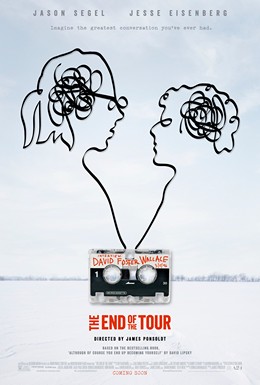
The second biopic starring Freaks and Geeks alumni (Really good year for them, by the way). This was the good one. While sometimes all talk, no show, and a bit slow at times, this is a very fascinating look into the nature of writing, friendship, fame, and jealousy. Jason Segel gives an excellent performance as David Wallace, who seems very normal, but is actually very insecure about his newly found fame, and Jesse Eisenberg as David(...) Lipsky portrays someone who wants that fame and respect, but doesn't show it. Their budding friendship and companionship, and the conversations which result, is the absolute highlight of this. Once again, knew little about the real story behind this, but this actually made me interested in that real story (it seems accurate, but Wallace's estate has denounced the film, so who knows), and maybe one day, reading Infinite Jest.
An hilarious look into a group of men who predicted the financial crisis of 2008, and decided to profit off it. While some of the jargon they used in the film was indecipherable to someone of little financial training such as myself, it manages to explain most of it very well (through the use of funny celebrity cameos). It really does illustrate the enormity of the mortgage crisis, and its mishandling by the big banks, and the ultimate consequences of it. It's a no-win situation. If our protagonists are wrong, they lose their reputation and their money. If they're right, the world economy collaspes. Actually, now that I write that down, the former actually doesn't seem that bad.
Yep, you probably expected this one up here, given the glowing recommendation I gave it early in the year. An enjoyable rump, which, rather than use brutally realistic fighting, instead uses fantastic and absurd violence to make this an excellent homage to the early Bond films. Colin Firth and Samuel L. Jackson both give great, memorable performances, and it is just damn exciting. The success of this film shows that a little absurdity in your action film could go a long way. Not much else I could say, that I already haven't. Just a fun, really good film. I hear they're making a sequel to this, and you can guarentee that I will be first in line to watch it.
I told most people I was going to see this in January. Because I thought that all the tickets were unavailable. Well, I actually looked, and found them, so....yeah, I was able to watch it shortly after its premiere. A worthy addition to the franchise, and a good starting point for non-fans, this proved that sometimes hype is justified. It was able to respect the original trilogy, while also trying to be original and fresh. Abrams captures what made Star Wars great, and managed to replicate, without feeling overly derivative or straying too far from that original premise (something Lucas himself failed to understand a decade ago.) With this film as the staring point of a new trilogy and franchise, I feel that Disney is making the right decisions in this case, and that the franchise will be "reawakened" (har har). But, you probably already knew that (and probably have tickets to see it again).
While this may not be del Toro's best work, it still very much still has his touch on it. Good characters, good story, great atmosphere. His presence and direction makes most of his films intensely watchable. While not big and epic like Pacific Rim, it still has that touch of passion. And it shows. Usually, I don't go for gothic period pieces, but this drew me in with an excellent mystery, which revealed more and more creepy and disgusting layers. This is a good ghost story, for people (like me) who aren't overly fond of ghost stories. However, it doesn't have many scares. Because it's not a horror film. It is a classic paranormal romantic drama, and it does that beautifully.
Now this is a horror film. A great horror film. One I watched purely on a whim. And it scared the hell out of me. Seriously, it is very creepy, very skin crawling. It doesn't use cheap jumpscares or excessive gore. No, the monster in this just takes the form of a human and walks very slowly towards its victim. It sounds somewhat dumb on paper, but the film is very well paced, and shot, which allows the tension to build appropriately as "It" approaches our heroine. It is so chillingly effective. It reminds of John Carpenter horror films, which are always very good. I was nervous the whole film, because the way "It" slowly approaches. It's the same thing that makes a Romero zombie work. They aren't monsters that lie in closets, waiting to jump out. They just walk slowly towards their victims, which actually makes them scarier, because they are single-minded, and seemingly inescapable. Some people said this was a metaphor for STDs or fear of sex. I disagree: This film is not about sex. Okay, it kind of is, but it is more about adulthood, and the fears that go along with that transition. It is very scary to become an adult, and that slowly creeping fear is very much represented, in a very scary matter. Months after I had watched this film, I still had trouble sleeping because I keep expecting "It" to come out. That is how much this film stuck with me. Like I said, it is bound to become a modern classic.
This was amazing. I don't know what else to say. This was a great adaptation of a great book. Drew Goddard managed to faithfully adapt the source material without being too dogmatic or too liberal. Just the right amount for a filmed adaptation to work. Matt Damon is incredible, funny, but still fearful and scientific. The rest of the cast is great too. Mars looks incredible. Almost like it came directly from the Curiosity or Pathfinder feed. The direction of Ridley Scott is fantastic, showing he can still direct. While it did have a lot of jokes, it still emphasized the enormity of Mark Watney's situation. This struck a perfect balance, With overly serious dramas flooding the market, a little humor is needed from time to time, and this movie knew how to adapt the irreverent tone of the book well. It also makes a great promotion of science, with the situation largely resolved through Mark Watney's ingenuity, and the ingenuity of Earth scientists to get him back. It also used very good scientific accuracy, as per the help NASA gave it. This film was so good, I watched it twice, and even though the second time I needed to go to the bathroom, I still sat, and watched the conclusion, that's how good it was. I can't recommend this film enough. Go, find a DVD or Blu-Ray copy, and watch it now.
I don't know how exactly to convey how well this film works. It just works, so unbelievably well. Sure, the concept isn't exactly original, but it's approach is very original and very intelligent. In years to come, this will probably be taught in psychology classes, because it illustrates the concepts of emotions and their effects very creatively. It really is one of Pixar's more cerebral, high concept films. It has all the Pixar hallmarks, great animation, memorable characters, and very striking emotional moments. (the marketing probably gave the latter away to you.) The casting was nothing short of perfect, including enthusiastic Amy Poehler as Joy, somewhat morose Phyllis Smith as Sadness (both from NBC comedies, by the way), and especially, Lewis Black as Anger. It had great jokes, great writing, and a fantastic message. One that isn't seen much not just in kids films, but really in some adult films. What really stood out is the sheer intelligence of the script, one which wasn't afraid to take certain risks, and treat its audience with a certain degree of intelligence. This very much shows that, despite recent duds from studio, Pixar can still make great films. And this will certainly be remembered as one of their classics.
--------------------
Well, that's my list for the year. Thanks you all for reading, and I hope to keep entertaining you into this new year, and many more to come. Happy New Year, folks. Here's a little familiar song:
It's time once again to take a look at Pokemon movies through the years. This year, we deal with the Advanced Generation, the generation of Ruby and Sapphire. This was after the spike in popularity Pokemon had in the late 90's. This was also the time, when the mythology of Pokemon was retooled to extend the world beyond the borders of "two creatures fighting each other." And this involved the soft reboot. New region away from Kanto-Johto, new weird Pokemon, new mechanics. But, the business of making the anime, and the Pokemon movies continued, with intrepid Ash Ketchum as the protagonist. So, let's take a look.
While travelling in the Hoenn region, Ash and his friends, Brock, May, and Max come across a carnival celebrating the arrival of the Millenium Comet, which, as the name implies, comes every one thousand years, . They enjoy the sites and sounds of the carnival, but find particular enjoyment in the magic act of a magician named Butler, and his lovely assistant, Diane. They hold a mysterious crystal, whose voice cries out to Max to come to him. This prompts Max to come on stage, and meet Butler, who incorporates Ash and Max into his act. After a disguised Team Rocket tries to kidnap Pikachu, and Butler is able to subdue them, Max asks about the crystal. We learn the crystal is actually the legendary Pokemon Jirachi, who can only be awakened every millennium, in the presence of a best friend chosen by destiny (and I realize how odd that just sounded.) Anyway, sure enough, Jirachi hatches from the crystal, and Max bonds with it. However, then, an Absol ( a Pokemon well known for coming before disasters, which the anime exploited extensively) comes, and attacks the group. Shortly after, May find Butler secretly bringing Jirachi to a strange device. We flash back to Butler presenting that same device to the nefarious Team Magma, in hopes of resurrecting Groudon, who will extend the land. However, the device fails, and Butler is humiliated. Back in the present, the device explodes again, and Max saves Jirachi. However, Butler then sends his Pokemon to attack Max and the group. However, Diane is able to save them. She reveals that Butler wants revenge on Team Magma for denying his genius. They intend to go to Jirachi's home in Fiorna, while Butler continues his pursuit. Can they get Jirachi to his homeland, before Butler is able to harness his power.
I'm just going to spoil the ending a little just to describe the best thing about this film. The fake Groudon at the very end looks incredible. The design looks great, a blobish sort of entity which vaguely resembles a Groudon, but also the fact that it literally feed off the energy of life and the Earth. That was a great concept for a villain. It is easily the highlight of the film. Also, the fact that normal, non-Legendary Pokemon actually help the protagonists was also a nice touch. The occasional use of 3-D was seamless.
The relationship between Max and Jirachi, while occasionally heartwarming, is not very well developed. It's fine, but it really doesn't hit the emotional nerve that the film wants it to. So, it really isn't effective. Also, the Team Magma connection with Butler really doesn't make sense. If he believed in their message, why does he want revenge for them scorning him. Perhaps it was just a hurt ego, but it doesn't make much sense in the context of the film.
I can't say much about this. It is very much a meh film. Not very bad, but not incredibly good. It's worth seeing if only for the fake Groudon, for it really is the most interesting part of the film. Otherwise, unless you want a complete run of all the Pokemon films, skip this.











_poster.jpg)